
How to Produce Euro Pallets with Consistent Dimensions?
For pallet manufacturers, logistics providers, and exporters serving the European market, Euro pallets are not just another product — they are a standardized infrastructure component that must meet strict dimensional, structural, and quality requirements to be accepted across the EPAL (European Pallet Association) exchange pool.
A Euro pallet that is 5 mm too long, has a nail in the wrong position, or lacks the proper IPPC marking will be rejected by European receivers, resulting in costly returns, replacements, and damaged customer relationships.
Producing Euro pallets with consistent dimensions — every single piece, every single shift — requires a precision-engineered Euro pallet production line that controls every variable from board cutting to final nailing and branding.
Understand the EPAL Specification Requirements
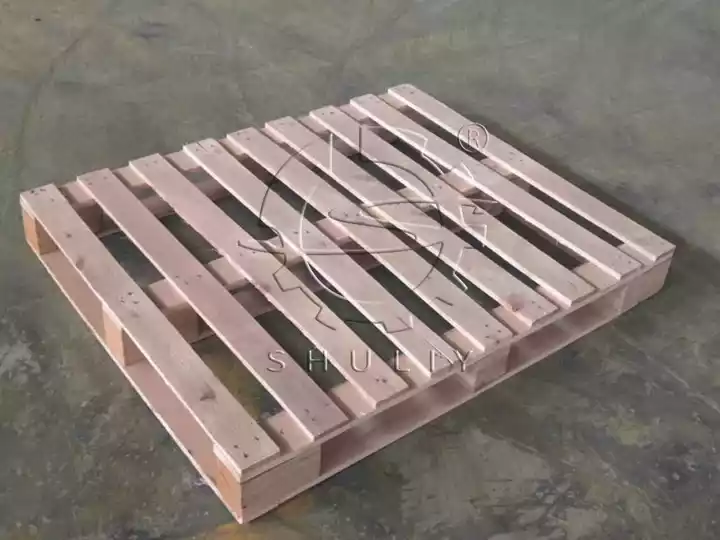
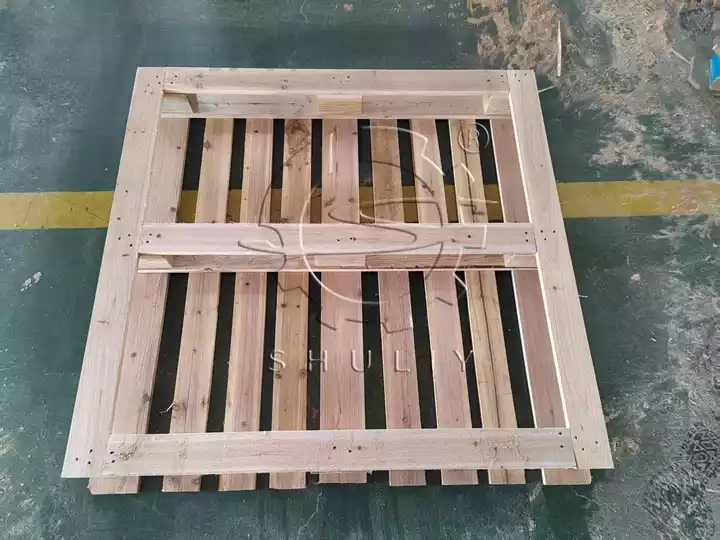
Before setting up production, it is essential to understand exactly what defines a compliant Euro pallet. The EPAL 1 standard Euro pallet has the following specifications:
- Overall dimensions: 1,200 mm (length) × 800 mm (width) × 144 mm (height)
- Dimensional tolerance: ±5 mm on length and width; ±3 mm on height
- Top deck: 5 boards — 3 wide center boards (145 mm each) and 2 narrow outer boards (100 mm each)
- Bottom deck: 3 boards perpendicular to the top deck
- Blocks: 9 solid wood blocks (78 mm × 145 mm × 145 mm) supporting the deck
- Nails: Specific nail types, lengths, and placement patterns defined by EPAL
- Wood species: Softwood (pine, spruce) or hardwood; moisture content below 22%
- IPPC marking: Heat treatment (HT) or fumigation (MB) marking required for international shipping
- Dynamic load: 1,500 kg; Static load: 4,000 kg; Racking load: 1,000 kg
These specifications are not suggestions — they are mandatory. A Euro pallet production line must be designed and calibrated to hit these dimensions and tolerances consistently, or the pallets will fail EPAL inspection and cannot enter the exchange system.
Precision Board Cutting Is the Foundation
Dimensional consistency starts with the raw material. If the deck boards, stringers, or blocks are cut to inconsistent lengths or widths, the finished pallet cannot meet the EPAL standard no matter how precise the nailing machine is.
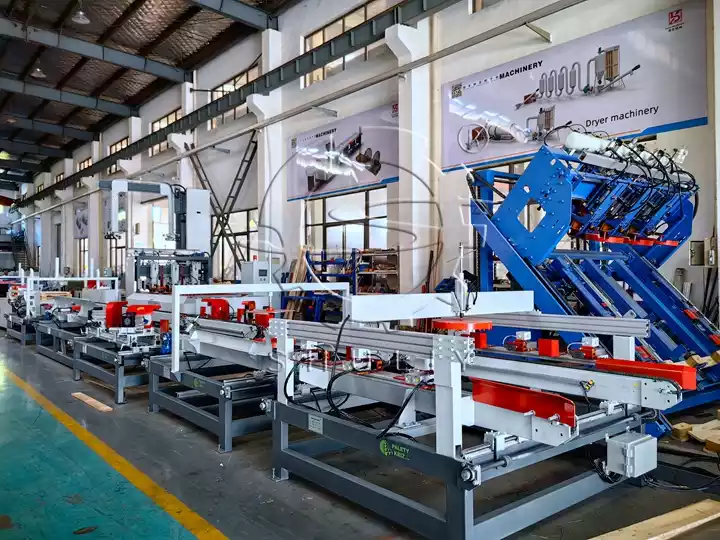
A complete Euro pallet production line begins with precision sawing equipment:
- Multi-blade rip saw: Cuts raw timber into boards of uniform width. For Euro pallets, the top deck requires boards at 145 mm اور 100 mm widths, while the bottom deck uses boards at 120 mm width.
- Cross-cut saw/optimizing saw: Cuts boards to exact lengths — 1,200 mm for top and bottom deck boards, 800 mm for stringer boards, and 145 mm for block stock. Length tolerance must be within ±1 mm.
- Notching machine: Cuts the entry notches in the bottom deck boards to allow four-way forklift access — a defining feature of Euro pallets. Notch dimensions must be precise to ensure fork clearance without weakening the board.
Modern optimizing saws use laser measuring and computer-controlled blade positioning to maximize timber yield while maintaining cut accuracy. This precision at the cutting stage eliminates the need for rework later and ensures that every pallet component fits together perfectly.


The Automatic Pallet Nailing Machine Is the Core
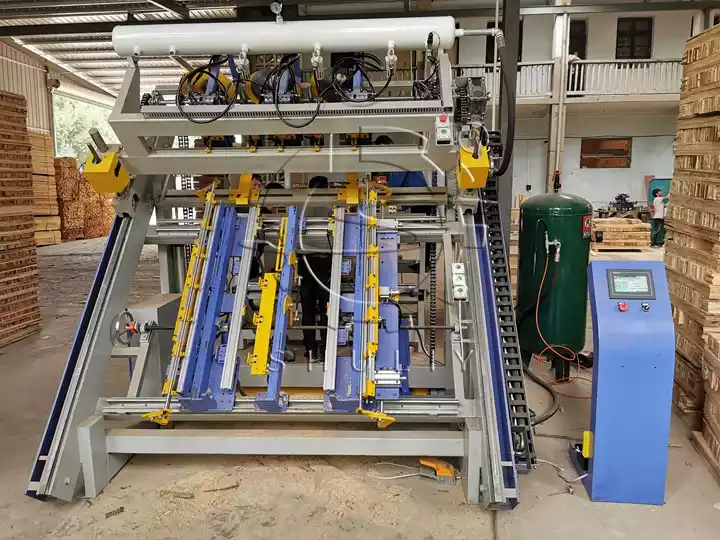
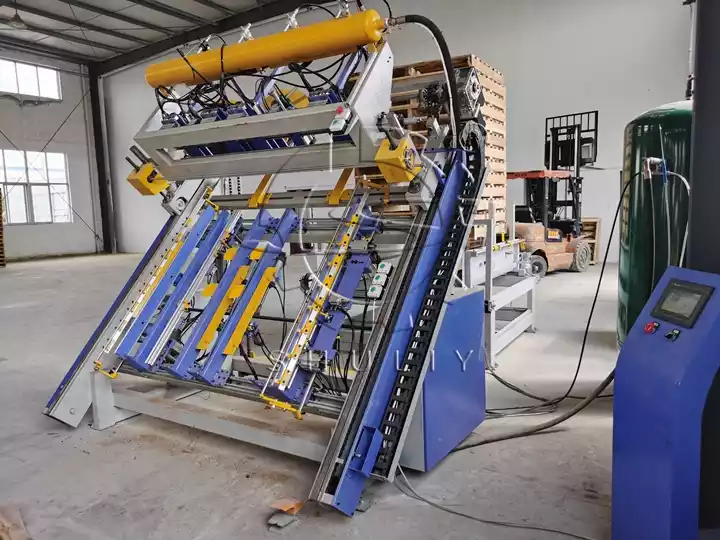
The automatic pallet nailing machine is the heart of the Euro pallet production line. It assembles the cut boards and blocks into the finished pallet structure, driving nails at the correct positions, angles, and depths to meet EPAL requirements.
A quality automatic nailing machine for Euro pallets offers:
- PLC and touch screen control: Programmable recipes for different pallet types (Euro, American, custom) with stored nail patterns, board dimensions, and cycle parameters.
- CNC positioning: Servo-driven nail guns position each nail with ±1 mm accuracy, ensuring consistent nail placement across every pallet.
- Multiple nail guns: Typically 2–4 nail guns operating simultaneously, achieving a nailing speed of 4 nails per second — 3× faster than manual nailing.
- Automatic board feeding: Boards and blocks are fed into the nailing station from magazines, eliminating manual placement errors.
- Nail detection system: Sensors verify that every nail is driven to the correct depth. Missing or incomplete nails trigger automatic rejection.
The nailing machine produces 50–80 Euro pallets per hour (approximately 400–640 pallets per 8-hour shift), with consistent dimensions and nail placement that manual assembly cannot match.
Automatic Turning and Double-Side Nailing
Euro pallets require nails on both the top and bottom surfaces. After the bottom deck is nailed to the blocks, the pallet must be flipped so the top deck can be nailed from the opposite side.
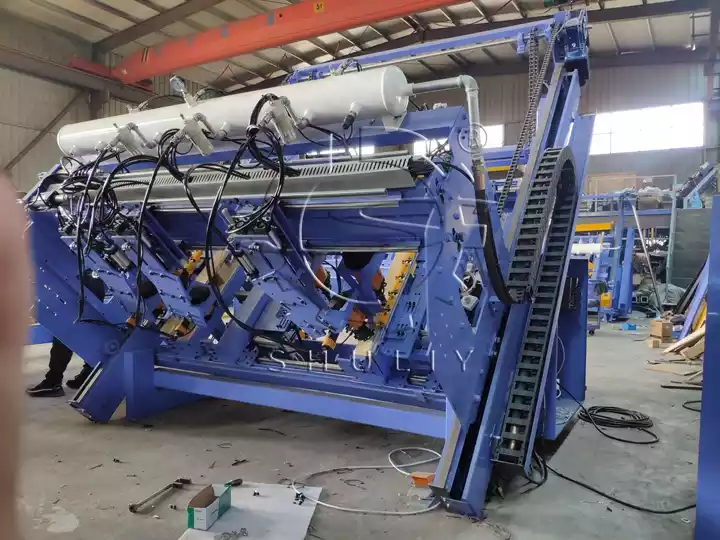
An integrated pallet turning machine (rotary turnover device) automates this step:
- The partially assembled pallet is lifted and rotated 180 degrees.
- The turnover action is synchronized with the nailing cycle — no manual handling required.
- The pallet is then transferred to the second nailing station where the top deck boards are attached.
- This automation ensures that both sides of the pallet are nailed with the same precision and eliminates the risk of damage during manual flipping.
In a complete Euro pallet production line, the turnover machine is positioned between the bottom-deck nailing station and the top-deck nailing station, creating a continuous flow from raw boards to finished pallet.

Chamfering and Corner Cutting for Four-Way Entry
Euro pallets must allow forklift entry from all four sides. This requires precise chamfering on the bottom deck board edges and, in some configurations, corner cutting on the top deck.
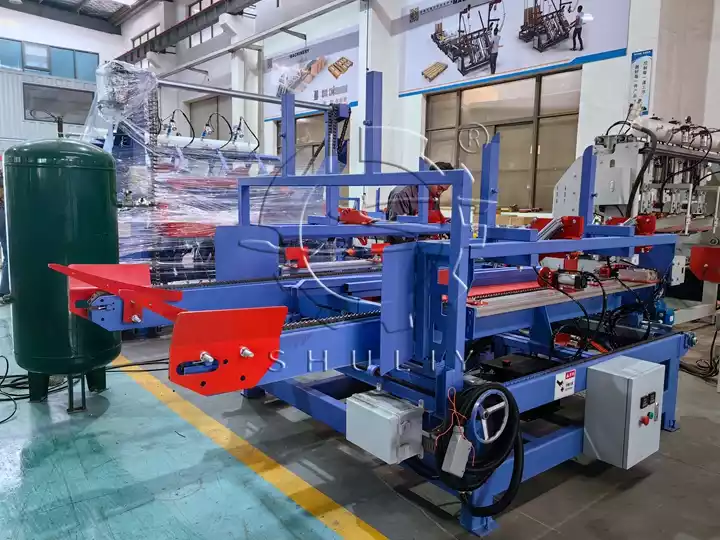
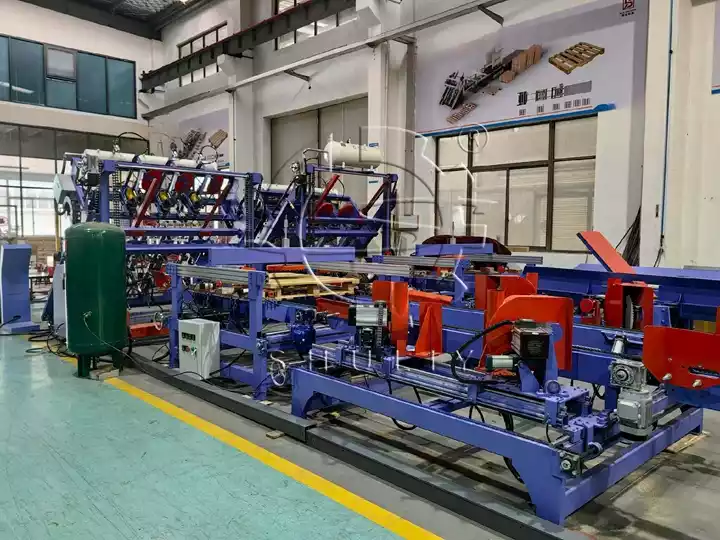
A pallet corner cutting machine and deck board chamfer machine perform these operations automatically:
- Chamfering: The bottom edges of the deck boards are beveled at a consistent angle (typically 45°) to allow smooth fork insertion without snagging.
- Corner cutting: The four corners of the top deck are rounded or cut at 45° to prevent damage to goods and to match the EPAL standard profile.
- Consistency: CNC-controlled cutting tools ensure every chamfer and corner cut is identical — critical for pallets that must stack and interlock properly in automated warehouse systems.
These finishing operations are often overlooked in basic pallet production, but they are essential for EPAL compliance and for ensuring that pallets perform correctly in high-volume logistics environments.
Branding and Marking for EPAL and IPPC Compliance
Every Euro pallet must carry specific markings to be accepted in the EPAL system:
- EPAL oval mark: Stamped or branded on the left center block.
- EUR oval mark: Stamped or branded on the right center block.
- IPPC mark: Indicates heat treatment (HT) or methyl bromide fumigation (MB); required for international shipment.
- Producer code: Identifies the licensed manufacturer.
A pallet branding machine (hot stamp or laser marking) applies these marks automatically:
- The pallet is positioned precisely under the branding head.
- The mark is applied with consistent pressure and dwell time, ensuring legibility and depth.
- Different branding dies can be swapped for EPAL, EUR, IPPC, and custom marks.
- The branding operation is synchronized with the production line, adding only a few seconds per pallet.
Proper branding is not optional — pallets without correct marks will be rejected by EPAL inspectors and European logistics operators. An automated branding station ensures that every pallet leaves the line with the right marks in the right positions.

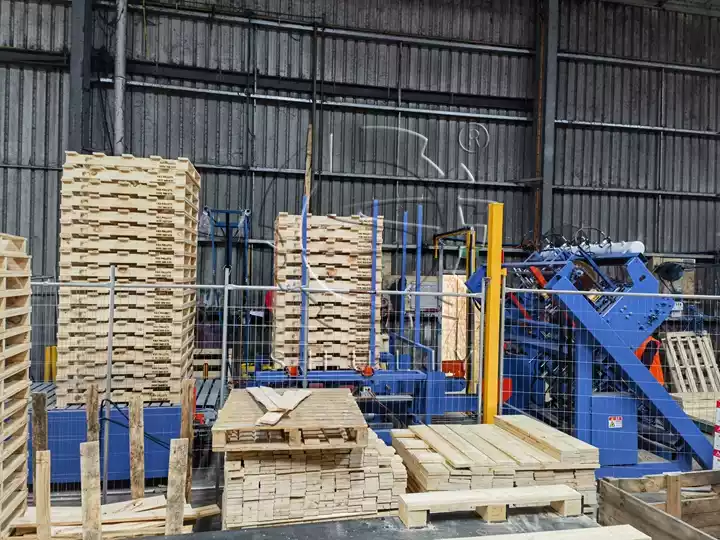
Automatic Stacking and Outfeed for Efficient Handling
After nailing, turning, chamfering, and branding, finished pallets must be stacked for storage, transport, or heat treatment. Manual stacking is slow, inconsistent, and risks damaging the fresh nails and corners.
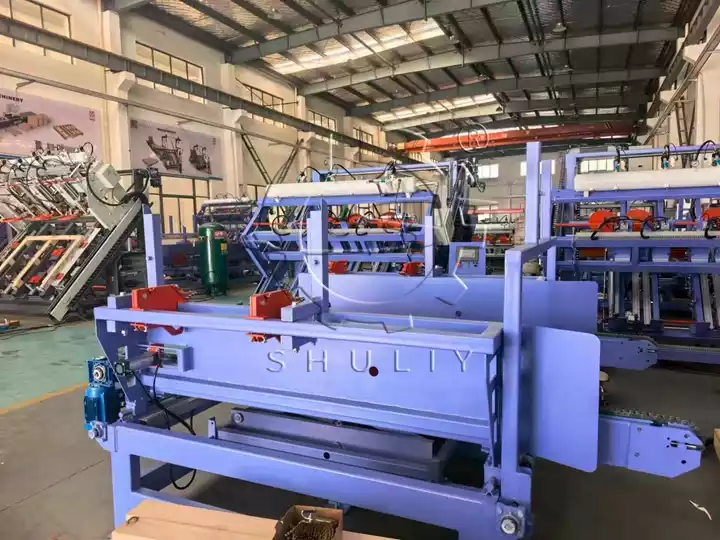
An automatic pallet stacking machine at the end of the Euro pallet production line provides:
- Programmable stack height: Stacks 10, 15, or 20 pallets per bundle — adjustable via the PLC.
- Alignment guides: Ensure each pallet is centered and square in the stack, preventing lean and instability.
- Gentle handling: Pneumatic or servo-driven lifting prevents impact damage to corners and nails.
- Forklift-ready discharge: Completed stacks are placed on the outfeed conveyor or directly onto a pallet jack.
Automatic stacking reduces labor requirements to 1–2 operators per line and ensures that pallets are bundled consistently for transport or ISPM 15 heat treatment.


A Complete Euro Pallet Production Line
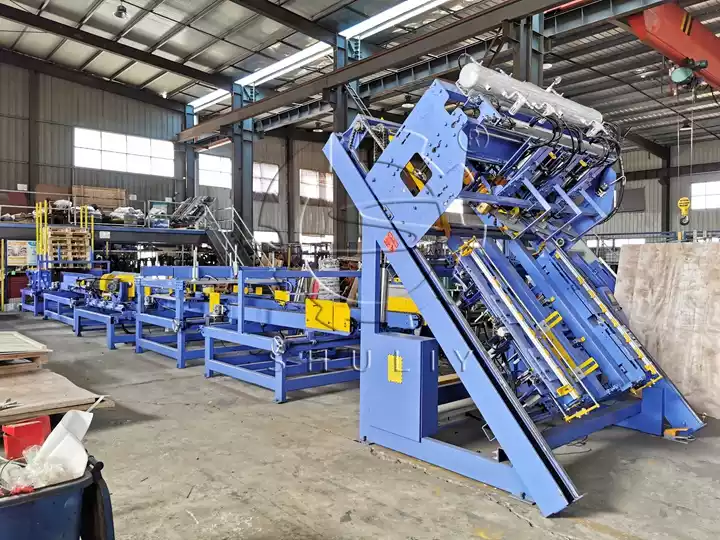
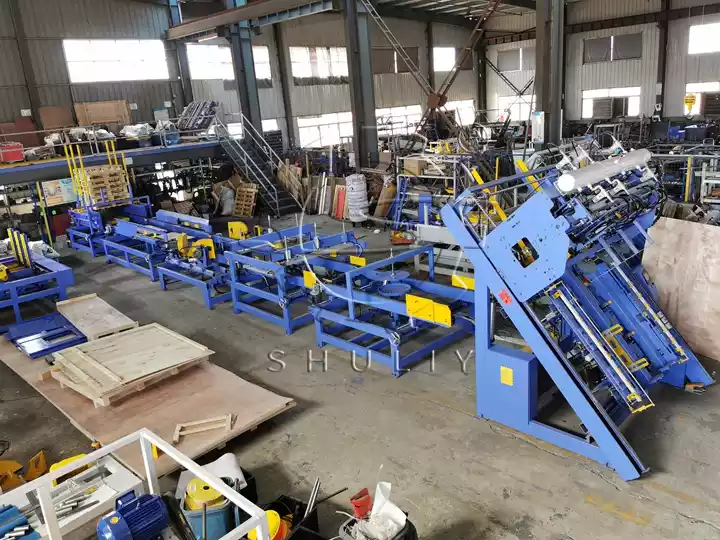
Producing EPAL-compliant Euro pallets with consistent dimensions requires a coordinated production line where each stage feeds the next with precision-cut components:
- Multi-blade rip saw: Cuts raw timber into deck boards of exact width (145 mm, 120 mm, 100 mm).
- Optimizing cross-cut saw: Cuts boards to precise lengths (1,200 mm, 800 mm, 145 mm) with ±1 mm tolerance.
- Notching machine: Cuts four-way entry notches in bottom deck boards.
- Block cutting machine: Cuts solid wood blocks to 78 mm × 145 mm × 145 mm.
- Automatic pallet nailing machine: Assembles bottom deck, blocks, and top deck with CNC-positioned nails at 4 nails/second.
- Pallet turnover machine: Flips the pallet for double-side nailing without manual handling.
- Deck board chamfer machine: Bevels bottom edges for smooth fork entry.
- Corner cutting machine: Rounds or cuts top deck corners to EPAL profile.
- Branding machine: Applies EPAL, EUR, and IPPC marks in the correct positions.
- Automatic stacking machine: Stacks finished pallets in uniform bundles for transport or heat treatment.
- Conveyor system: Transfers pallets between stations in a continuous, synchronized flow.
A fully integrated Euro pallet production line produces 50–80 compliant Euro pallets per hour with dimensional tolerances within ±3 mm — meeting EPAL standards for exchange pool acceptance.
Ready to Produce EPAL-Compliant Euro Pallets?
Whether you are entering the European logistics market, expanding your pallet manufacturing capacity, or upgrading from manual assembly to automated production, a precision Euro pallet production line is the foundation of consistent quality and EPAL compliance.
We provide complete Euro pallet production lines — from timber cutting and notching to automatic nailing, turning, chamfering, branding, and stacking — all engineered to produce EPAL-compliant pallets with tight dimensional tolerances and consistent structural quality.
Contact us today for a free consultation and quotation. Send us the following details, and we will respond within 24 hours with a customized equipment recommendation and price:
- Your target output (e.g., 400 pallets/shift, 600 pallets/shift, 800 pallets/shift)
- Your pallet types (EPAL 1, EPAL 2, American stringer, or mixed)
- Your timber supply (softwood logs, sawn boards, or recycled timber)
- Your board dimensions or whether you need integrated sawing and cutting
- Your certification requirements (EPAL license, ISPM 15, CE, etc.)
- Your available workshop space and location
- Any special requirements (voltage, automation level, heat treatment integration, etc.)
Reach out now and let our engineers help you build a Euro pallet production line that delivers consistent dimensions, EPAL compliance, and reliable output — pallet after pallet, shift after shift.